
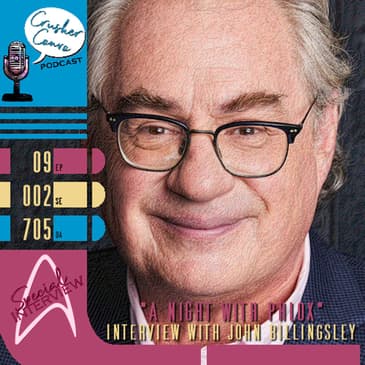
I had the honor to sit down with none other, John Billingsley, from Star Trek: Enterprise. We discussed his love for books, his passions for the Hollywood Food Coalition and PanCan and what Star Trek means to him.
NOTE: These episodes are off a LIVE broadcast that you can see at my YT channel @CrusherConvo. You can also find me on Instagram and Threads! I am not affiliated with Gates McFadden or her team. This is a fanbase podcast that just admires and enjoys her work!
Website: crusherconvo.com
TeePublic: teepublic.com/user/crusher-convo
Patreon: patreon.com/CrusherConvo
Buy me a Coffee: buymeacoffee.com/crusherconvo
[00:00:00] I think I'm saying that we struggle all our lives to answer it, but it's the struggle that is important. That's what helps us to define our place in the universe. This is Beverly, Dr. Beverly, Dr. Beverly Crusher. Honest. Forceful. Trusting. Brilliant. Strong. Adventurous. And this is Crusher Convo.
[00:00:30] And welcome to Crusher Convo, where we are crushing the conversation one episode at a time. Today I have another doctor in the house and who is gracing us with his presence. We have Dr. Phlox himself, John Billingsley. Hello, John. Hello, hello, hello. Thanks for having me. All right.
[00:00:48] You know, Gates McFadden said when you were on her podcast that you are free, spontaneous, completely wacky and a sweetheart. And I absolutely agree. And so I thank you so much for joining me today. My pleasure. As I like to call her Boots McGatley.
[00:01:02] I don't know why, but for some reason I could never quite remember her name years ago when I didn't know her. Just watching her show a little bit. It was like, what's her name? She's got a weird name. It's something with Gates. It's Boots. Boots McGatley.
[00:01:14] I think it's Boots McGatley. And for years they called her Boots McGatley. And then, you know, it took me a long time after I actually met her to stop calling her Boots McGatley. I don't know why. I don't know.
[00:01:23] I see a t-shirt coming on all of a sudden we'll wear it at Vegas and... I just see my little, my little... Look it's Boots McGatley. Yeah. And I'm sure she would respond to it too, right? I told her that.
[00:01:34] I think I don't think she remembers that I used to call her Boots McGatley. Unfortunately, I won't be in Vegas this year, but I remember last year I had run into you because, you know, the hallways are so tight with people. Indeed they are.
[00:01:46] I had run into you while you were heading to the bathroom and I was like, I'm so sorry. You're like, it's fine. And then you... That was our only encounter in person. Yeah, the older you are.
[00:01:55] The younger you get, the less time in between bathroom breaks, you know. Oh, I'm sure. Those bathrooms are far. Five minutes. They are. They are indeed. They are far.
[00:02:05] And if you're on Star Trek, you know, it's hard to get from place to place without saying hi to folks. So you have to give yourself a little bit of travel time. A little bit, right? Yeah. So I'm going to go ahead and jump into our question.
[00:02:18] I like to say we've already talked about going to the bathroom. It took about 36... It took a big step out of the way. Yeah. So, you know, I was looking into your story and all that stuff and it showed that you were born in media, Pennsylvania.
[00:02:33] You lived in Alabama, Louisiana, and Connecticut. So you bounced around a little bit as a kid, but can you tell me of like one amazing thing about your childhood that you even feel like resonates with you today?
[00:02:45] Reading is the thing that is what marked my childhood and why I will always be eternally grateful to the memory of my dear parents. They inculcated in me a deep love of reading. They were always huge readers. They read to me at night.
[00:03:02] They clearly loved to read themselves. They were always in the middle of a book. They had, I remember in Connecticut, particularly Florida, ceiling bookshelves in the living room, and I would sit in front of them even before I really...
[00:03:14] I think I would have been maybe eight or nine years old so I could read, but I wasn't up to adult material. But I knew the day was coming. I would just pick books out of the shelf and kind of fondle them in expectation of the day.
[00:03:28] Waiting for that moment. Yes. So I was fortunate enough to be able to grow up as an avid and passionate reader. What was your favorite book as a kid? You know, that's always impossible to say.
[00:03:44] I imagine if it's like asking somebody who's got a bajillion kids to pick a favorite, you like the kids for their different qualities. Every book is its own unique and wonderful thing. Growing up, if there were books that I remember really clearly, A Tree Grows in Brooklyn by
[00:04:00] Betty Smith, I remember thinking was absolutely gorgeous. I was a voracious reader, but I was also sort of a bizarrely indiscriminate reader. For a period of time, in fact, when I was a young teenager, I would go to the library
[00:04:17] and I would concoct these absolutely ridiculous games like I would say, okay, I'm going to check out of the library every 20th book in the R section in fiction. And I would take like five books by a writer with R.
[00:04:33] I would know damn thing about them and those would be the books I'd read because I thought, you know, it's like, I'm just, you know, I don't know enough about the world of fiction. So let's just try.
[00:04:44] And so I ended up reading things that I wouldn't probably not read now and would never have read some of which I adored, some of which I'd like next time. Yeah, not going to read this one again.
[00:04:59] I mean, I couldn't tell you were an avid reader with the line of books. Are we on is this a is this a pure audio podcast or people going to see? No, it's going to be video. Yeah, people will see all your.
[00:05:12] Well then yes, yes, I have it's a sickness. It beats heroin is what I always tell my wife. I'm not sure it actually does beat heroin now. I know I kind of think like heroin isn't dusty if nothing else. I was a heroin addict.
[00:05:26] I wouldn't sneeze as much probably. I think about 15,000 books. This is this is one one stack in one room. My best friend has her grandfather had a bookstore here in town and he had it for years. They had to retire.
[00:05:42] They had to close it down and he got sold like three. He's got 300,000 books. Oh, talking like old books like I have books that were like 120 years old. Still in condition.
[00:05:56] I mean, if I had if I had world enough in time, you know and could live forever and had the money to to invest, I would definitely have a gargantuan house big enough to construct my own private library books. Yeah, yeah.
[00:06:14] Yeah, but you know just because I want to live in a library. I want as a kid I would skip school to go to the library. I would go out and do heroin.
[00:06:24] I would call my parents and say, well, you know, didn't feel like going to school today called my mom didn't feel like going to school today went to the library. She said, you can't.
[00:06:32] Okay, I'll pick you up and she'd come and we spend the entire day in the library together. Well, I mean, school, your in books library read books. I mean it's educational.
[00:06:42] I have a bizarre rebellious streak that I've never really been able to entirely understand as soon as somebody signs a book. It's like, fuck you. I'm not going to read that. So school school was not actually for me about reading was about pretending to have read.
[00:06:59] I even in college, I remember going to the library and wandering the stacks get pissed off that I had to read the books that I was signed when I wanted to read this this and this right.
[00:07:12] I had to go back and read all the books that were assigned that I rebelled against reading at the time and have loved most of them, but you know, yeah. I'm going to ask all basically is is really what it feels like.
[00:07:27] We all have that tendency depending on what it is right. I think it you know we have a passion for something and if we're really passionate. You have to grapple with a book in school.
[00:07:39] You know, it's one you have to have classroom conversations which I didn't really particularly want to have and you know you're reading it right. It pays and they're quizzing you want it. It's like, you know, if you make reading a book work instead of letting it be fun.
[00:07:51] I think you kill the possibility of joy for readers. There's a part of me. I ain't no pedagogue. Yeah. You know, far be it for me to tell people who teach for living out and do their gig.
[00:08:04] But it always struck me that if I was given a classroom, I would say, okay, here's the gag for an hour. I'm putting everything out in the table you could possibly take an interest rating. You know, hope magazines at sci-fi novels. It's great literature.
[00:08:18] I don't care what you read. You don't have to talk about it. You don't have to write about it. All all this is an hour just read. No talking. Just read. Just read. Yeah. I think some teachers do that to be honest.
[00:08:34] I think some teachers would love to do it but unfortunately we have a system that relies on grades and you know measurements and etc. I mean, I think we've done sometimes ourselves a disservice by making everything unfortunately metric. Instead of saying. All the protocol and all that. Yeah.
[00:08:53] Yeah. It's just, you know, teach to the test. I mean, unfortunately, you know, but yeah. Now of course your parents were not actors. So how did acting get into your life?
[00:09:05] Well through reading because when I moved up from Louisiana, I caught like this and I had a list. And so I was ostracized ostracized. That's a strong word. I wasn't. I was a freak in school and not beloved.
[00:09:22] But they had mandatory school auditions, mandatory fifth grade auditions for the play that the fifth grade was going to present that year, which was a Christmas Carol. And because I was a reader, I was actually able to lift the words from the page with some degree of passion.
[00:09:40] So I was cast as Gruge and the star. I was the star of the school play. And so for one brief shining moment, I went from pariah to to to star. And of course, as soon as the play was over, I went right back to being pariah again.
[00:09:59] But for those three weeks, it was like, and thus a love of acting was born pure ego, you know, my parents were gracious enough to see that this was something I enjoyed and all kidding aside, they set me up with some classes.
[00:10:15] With a couple of soap opera veterans I lived in Connecticut at that point, the suburban community bedroom community outside of New York, Ed and Dorothy Bryce. And I took classes with them on and off all through high school.
[00:10:30] There's no way God's green earth my parents were gonna let me try and be a professional actor. I mean, I wasn't gonna they weren't going to let me go into the city and audition and I knew better than to even push that that wasn't really on my radar.
[00:10:43] When I was ready to go to college, I said, hey, you know, I just assume and actually skip college and go to acting school was like that ain't gonna happen.
[00:10:52] So I made a deal with them that that I would only apply to girls schools that didn't have grades. And that is indeed what I did. I went to Bendington College because of the ratio I thought of girls to boys was advantageous to me.
[00:11:07] And I didn't have to take classes I didn't want to take and they didn't have grades. And I actually went to be a writer and realize that's too lonely. I was too social. So I pretty good acting teachers there, Bendington College.
[00:11:21] So I became an actor and then my parents were like, I can't believe we didn't force them worthwhile. We should have been meaner to him as a child. Well, you know what? You have a lot of credits to your name now it's like 169 so far.
[00:11:38] Yeah, I know I wish my parents had lived long enough to love their noses and it's like I told you so. Like I got this. I mean, you are one of those character actors where it's like I know who that is.
[00:11:49] Now a lot of your roles we know you from like X files diagnosis murder Gilmore girls Stargate SG one angel and my favorite bones. So and of course this little show called Star Trek Enterprise. I don't know if anyone's heard it but it's out there.
[00:12:02] Was there any ever role you just absolutely had the best time of your life. I really I mean it's not necessarily my my metier but I really enjoyed doing Stargate because Star Trek Star Trek. My wife is always correct in my pronunciation.
[00:12:22] They're very anal about getting the words just so and while I was on Star Trek I had a little window in my schedule because I wasn't
[00:12:31] necessarily featured in every episode and I was able to go up to Canada and do an episode of Stargate where everything was wild
[00:12:38] and woolly and they let you kind of pull it out of your ass and I got to work with a wonderful Canadian action named Patrick McKenna who and we were to play two goofballs.
[00:12:48] And that was just a wonderful kind of clowning around week that was such a nice break. I loved being on out of time with Denzel even though he was a kind of a tricky cat to get to know as a person.
[00:13:00] He's a marvelous actor so getting to getting to have screen time with him was a treat. Nice and nobody would know it but I was a theater actor for a while and so getting to work on some check off plays with some people who are
[00:13:15] very dear friends and colleagues way back in the day in Seattle. And probably lastly I was also a co-founder and artistic director of a theater company devoted to adapting actually presenting fiction verbatim on stage.
[00:13:28] Eventually it became adapting fiction for the stage that company lasted for 30 some years well after I left it but starting it working on a lot of wonderful pieces of fiction was definitely a great highlight of my career that five years in my life.
[00:13:47] Now is it always interesting to do that like improvisation you know especially with plays and stuff you kind of get to do your different thing did you get to improvise a lot in your scenes or with any character you got to do.
[00:14:00] Theater itself is unless you're specifically doing improvisational comedy or you're using improvisation as a rehearsal tool is not improvisatory I mean you've got a script and you're expected to adhere to the script.
[00:14:14] Film and television is rarely improvisatory once in a blue moon you're on a show and that's why the first thing that came to mind was Stargate.
[00:14:23] Once in a blue moon you're on a show where the attitude is look as long as we're telling the story you can feel playful within the script not really improvisatory in the sense that they're kind of like saying hey we don't even know where we're going go for it I won't go I'll go on you.
[00:14:41] It's it's sort of like you're within a the channel of the river is wider. So you've got a little more elbow room and when that happens I find that to be great fun.
[00:14:51] Usually it's not the way it works usually the writers understandably, or rather you know attached to the words they wrote right at a Ford to encourage actors to muck around because if everybody mucked around the whole thing would become a baggy mess.
[00:15:07] It's not often that you find a situation out of time actually was another instance where they let me you know I'm pretty good at it and and I can usually you know tell the difference between an improvisatory opportunity that still hones what you're doing and holds to the demands of the script as opposed to some people I think who use improvisation
[00:15:30] and they go wild and they fuck it the whole thing up right I found that I'm I'm when people trust me to play I can play to good purpose. Right, right.
[00:15:42] Now I do really want to talk about your time on bones because no one ever talks about my time on bones I will say I love bones.
[00:15:54] My wife is in the pilot of bones did you know that I know and I was just about to mention that so not only you but your wife was on the pilot she everybody in Hollywood that show ran for 29 years so there's an actor in Hollywood that hasn't been on bones.
[00:16:07] Right, right. I mean she was a I remember the characters named Clua Ellers mom. That was the character she played.
[00:16:15] And so, but you know so those episodes were actually very important to the series but your particular episode you had Nora Dunn, Gabriel Tigerman and Sean God so how was it on the set of that episode any funny stories or just.
[00:16:31] Well you know I don't I don't recall. I don't recall that episode terribly well in part because I think most of my scenes were, we're not necessarily with the other care I think I had one scene when I was with Nora Dunn.
[00:16:48] I was a red herring as I recall. You have the inevitable you have the inevitable scene where they interrogate you thinking, is it you and you go suspect because they chocolate and the Marlowe. Yes, it's like, I'm really a red herring sir.
[00:17:08] So, however what I will say about that episode is that Dave Thomas, the marvelous comedian from sc TV days. I didn't know that he had written the episode I don't think he did but he was one of the writers on the show.
[00:17:24] And you know, I'm a big fan of sc TV john candy and I mean, you know, marvelous group of fabulous comedians.
[00:17:31] So Dave Thomas was sort of like a little hero to me so I, you know, chatted with him and he couldn't have been more gracious we ended up going out to have lunch and that that was certainly a high nice. I mean, the woman of the lead.
[00:17:45] I mean, I didn't get to know the cast terribly well you don't when you're a guest star. But you always know the people on a show who just have have an infinite capacity for kindness.
[00:18:00] And there are invariably people on every show who just strike you immediately is like deeply warm deeply welcoming the woman who played the lead on that show I just adored. Yeah. Yeah. Yeah. I mean, and you guys.
[00:18:14] So how was the dialogue was it easy for you with all that tech doble after doing like, oh yeah, yeah, no, I mean really the only the honest thing and whenever anybody asked about that it's all dependent upon how much time you have every now and again for various reasons that are elusive, you know to me sometimes
[00:18:30] you get the script the night before, or there's a rewrite that you get the night before the older you get the harder it is to to cram the lines in overnight.
[00:18:42] Right. I mean David Milch notoriously the writer behind Deadwood and the guy who wrote many great episodes of NYPD blue.
[00:18:50] He was always rewriting he was rewriting right up until action and Jimmy Smith quit NYPD blue in part because he was so sick of being handed a script and told to perform it without any prep time. Right.
[00:19:03] That's when you kind of tear your hair out as long as you have a couple of days, it doesn't matter how complicated the dialogue.
[00:19:10] You'll be fine on Star Trek every now and again. They switched out an alien name on you at the last minute, you know instead of the Trentorians that became the Bejusians.
[00:19:20] It's like I'm sorry, I've got Trentorian in my head and every time I say these lines, I'm going to say Trentorian enough Bejusian. And that was sometimes but you can fix that in post at the same at the same right.
[00:19:34] Now, so with Enterprise so we'll just jump right into that. Did you just like oh there's an audition I'm just going to go for it where you.
[00:19:43] Yeah, well I'm going to go for it. I'm going to go for it suggests that I get to pick and choose. You don't get to pick and choose.
[00:19:51] If you get auditions particularly when you're younger and you're still kind of trying to make your way it's like, oh yay fabulous yeah you go out for them.
[00:20:01] I'm older and I don't need to make a buck. I will definitely say me my schedule doesn't allow me I don't want to shoot in Croatia actually I love to shoot in Croatia, but you know you can pass on shit back in that day it was like please give me an audition.
[00:20:15] So yes, it was you know Star Trek audition. One is certainly aware of what that means you know should you get a series regular and Star Trek it's you know it's like you buy a house has a. Yeah, now since Enterprise was the prequel though how.
[00:20:33] How was that process with flocks like were you directed to be like this is how the character supposed to be no idea.
[00:20:40] I told this story a lot so for those of you who are listening and heard it in times feel free to go to the bathroom and come back and. Intermission.
[00:20:49] For those of you who have not heard it I really perplexed as to why you haven't heard it and why you're watching me because clearly you could really I have it because.
[00:20:58] They don't give you a lot of the material for a pilot sometimes they give you the full script sometimes you're a little precious about it I did not get the full script I got a scene a single scene.
[00:21:08] And the only instruction was he's an alien and come in with a slight alien accent was like. All right, fine, whatever that means descriptive.
[00:21:19] Yeah, so it's like so I worked with the misses and I tried a bunch of silly voices and I came in with the voice pretty much some fairly similar to mine with a slight adjustment to make it flocks in.
[00:21:29] But what I did add because I was feeling pukkish was in moments of the script. The scene was very much about a guy who's optimistic and buoyant. And I thought okay perhaps in moments of you know high buoyancy he squawks in delight so I squawked a bird.
[00:21:46] So I auditioned and when blah blah blah blah blah blah blah blah blah blah blah blah blah blah blah blah. And, alone behold, they like me and I get called back and it's like, oh shit, do I squawk?
[00:21:58] Do I squawk during the callback nobody said anything so I guess I'm going to be a bird and then I get the final audition where I'm going to network and there's nobody else there.
[00:22:08] I'm competing that I can see so it's like it's mine unless I really fuck it up. I squawk like a bird. I get the part. So I'm fairly convinced I'm going to be a bird. I'm like, you know, I'm flabbergating the backyard.
[00:22:21] I'm like, you know, pecking at worms. I'm like, okay, Dr. Flux, he's a bird. But they're not making me look like a bird the makeup tests. Right. You know, nobody says anything about me being a bird. They're not dressing me like a bird.
[00:22:35] I'm like, am I a bird? And I asked Brandon at the table read where I also squawk at the end of the table. He said, so look, nobody said a word to me. I'm kind of thinking he's kind of like a bird. Am I a bird?
[00:22:49] And they went like, what the fuck is that? That's like what I, I. What do you want from me? So the day we shoot, I have no fucking idea. Do I squawk? Do I not squawk? Am I a bird? Do I flap my eye? What do I do?
[00:23:09] So the very first time I had cause to actually try the squawk, first seeing that sort of like calls for it. I and the director, I won't say his name because I can't remember it.
[00:23:23] The director says, John, quit fucking around, which is how I knew I wasn't a bird. It was like, why didn't somebody? Now, now at the time I was kind of pissed off. But now that I have dined out on that story for almost 25 years,
[00:23:39] I'm very happy it played out the way it did. But you know what? It's funny. This is so opposite of what you just talked about 10 minutes ago about there's no, you know, impromptu. Well, and clearly, and clearly there wasn't supposed to be. I could have said something. Yeah.
[00:23:58] It brings me back to the story with the Ferengi where like the director didn't know what these aliens were supposed to be. So he was like, just jump around like monkeys or whatever. So there's Armin and the other guys just like, okay.
[00:24:09] And that was the complete opposite of what the Ferengi were supposed to be. So I think there was a lot of people not on the same page. They were still trying to figure it out. Yeah, exactly. Arring up the wrinkles.
[00:24:20] Well, I always thought like, well, how do you justify the fact that nobody's seen it to noblin before? It's never been mentioned before. Well, I thought, okay, he's from a very monastic planet. There are only like seven denobelans left. I'm like one of a dying breed.
[00:24:32] And then it turns out we're the fuck bunnies of the universe. And they're like, you know, everything is 18 wives and 30 kids. And I actually left the planet just to get a little, you know, elbow room. So, you know, the actor can make up whatever the actor wants.
[00:24:44] And it's probably going to be invalidated by what the writers decide in the end. Right, right. I'm kind of excited because I just finished forage. Aren't about to start enterprise. I'm not seeing one episode of it.
[00:24:56] I'm a guest on your show and you've not seen a single episode. I've seen the finale, which was just because. Oh, you know, I mean, John Billingsley. I can be some guy. I know your doctor, uh, harkness from both. Well, God, I hope you don't hate it.
[00:25:17] You know, you can fast forward through the scenes. I'm not in if you want. I was just told to fast forward through the song. But the song, I don't really quite understand the loathing for the song. Although early on, you know, we were filming our first episodes during 9 11.
[00:25:39] And so, uh, you know, obviously, you know, incredibly horrible and painful period in world history and American history. But a couple of days after 9 11, um, I'm going to Paramount and there are a group of people outside carrying signs and picketing.
[00:25:55] And I'm thinking, oh, this has to have something to do with 9 11. I wonder what it is that, you know, is causing people to pick it. Paramount having to do 9 11. And as I drove in, I realized they were pickets were saying, we hate the enterprise theme song.
[00:26:07] We hate the enterprise. Surely there are bigger fish to fry these days. And but wow, you must really hate the man. I mean, you know, that's, uh, so that's when I realized one, how passionate
[00:26:23] Star Trek fans can be right and to, oh, we're not going to do very well. If people are picking the same song with that much of it today. Uh oh. And unfortunately, you guys only made it to four seasons.
[00:26:36] So was there anything with flocks that you wish you got to do? I wish I'd gotten laid. I, you know, I think every other character, I think that's why he said, I need, I need a breather. I guess so, I guess so.
[00:26:47] There was a woman named, uh, what was her name? She played ince and cutler in the first season and she would have been my, my, I think it seemed to be working that she might have been my girlfriend.
[00:26:58] Um, although she was ridiculously young and far too pretty for me. Uh, so I don't know how they could have justified that, but she was a Kelly Waymeyer who was a marvelous actress. And I think if, if she had lived, she had an undiagnosed heart condition.
[00:27:12] It was a tragedy. They found her. Um, yeah. Dead at home on herself. A fabulous actress was really beginning to establish herself in Hollywood. And you know, I wouldn't have been surprised if they'd asked her to become a regular.
[00:27:26] Um, whether she would have wanted to do it or not. I don't know. But, uh, um, with, with her death died to my romantic life. I never had a, uh, beyond that, no, I, I, as an actor,
[00:27:40] my general feeling is as opposed to Bob Bacardo who used to hide in the shrubbery and leap out at the writer on Voyager to convince them that he should sing opera or have him an affair with seven of nine or whatever.
[00:27:51] I always heard it like it was like, you know, my job is to say the words. My job isn't to write the words. So I'm not, I'm going to leave you alone. Um, I think I pitched a few things every now and again.
[00:28:02] And they, uh, they always, I pitched the idea at one point in time that perhaps now that I know you haven't watched the show, I don't even know if I can continue with conversation. Cause you don't know what the fuck I'm talking about.
[00:28:12] You're totally fine because I, I know a good, a decent amount. I just haven't seen the episode. So there, there, there, there, I thought, you know, hey, how about an episode where you pick up a denobulant ship in distress
[00:28:23] and all the nobulants that come on board, they're like complete sloths. They leave their underwear line around to eat all the food. They're shagging out in the public. It's like, oh my God, get these guys off the ship.
[00:28:33] But they all look like that was what, that was what I was really trying to get at is every denobulin looks exactly like me. So that, you know, against the possibility that there could be spin offs down the road, I would play all the denobulants,
[00:28:47] which is, it's grill something I kind of throw out because we haven't seen a shit loaded denobulans and subsequent iterations of Star Trek. Right. I think we are long lived.
[00:28:58] If they all look like me, uh, you know, I, I, but yeah, that isn't, that isn't Terry metallis is not returning my phone calls. So that's not, that's not apparently going anywhere. Well, I mean, you never know, you never know.
[00:29:12] Oh no, this, I know, and I know this is what will happen invariably because this always happens. I always make a joke and somehow it gets back. Billingsley pissed off the denobulants are billingsley clamoring to be returned to it's like, Like I was just a thought.
[00:29:28] My thought does not translate to the yellow press I have found. Right. Right. Now my next one actually, I'm going to go ahead and bring this up. I do want to talk about these organizations that are near and dear to you, the Hollywood food correlation and Pancam.
[00:29:46] So how did you get involved with them? And why do they mean so much to you? Well, I'll start with Pancam, although that's certainly the most recent for me. My mother passed away from pancreatic cancer in 1990.
[00:30:02] And at that time, the survival rate for somebody was diagnosed with pancreatic cancer was about 2%. And indeed my mother, by the time they realized what she had, they gave her zero chance of survival. It was like, sorry. Right. It's a very fast growing cancer. It's hard to diagnose.
[00:30:22] It's hard to realize that you've got symptoms that might be indicative of pancreatic cancer. So this organization and some other organizations that have raised awareness and have helped people realize that if they have bowel issues, tummy issues, lower back issues, not to assume that it's nothing. Right.
[00:30:45] But I think the pancreatic cancer network does a lot of terrific work. But more than anything, I think raising the awareness of the possibility that you need to take quick action if you have anything in your family history to suggest that pancreatic cancer might be an issue.
[00:31:00] It was brought to my attention by Armand Schimmerman and Kitty Swank. Kitty is a 20-year survivor of pancreatic cancer. Yeah. We, working with Jonathan Frakes, whose brother died of pancreatic cancer, have been helping to raise money in support of this really terrific organization.
[00:31:16] In large part by participating in their annual event which is called Purple Stride. Every year in the spring and some 50 communities all over the country, people dress up in purple and they take a walk to raise awareness.
[00:31:35] We, just like walks for all sorts of causes, we raised this year more money than any team has ever raised for this cause which I'm very proud of. We raised over $1,000,000. Wow. And again, check them out if this is of any interest.
[00:31:54] If you know anybody who has pancreatic cancer, this is an organization that will help you find support services, will help you find a second opinion. They sponsor a lot of research. They do a lot of lobbying. They have a national reach and a national scope.
[00:32:11] I think they do terrific work. Hollywood Food Coalition is an organization I've been involved with for eight years. And that, that is a longer conversation because I go way back working with social service organizations.
[00:32:27] I've always had a strong interest in trying to help promote support for people in need. The food coalition is 38 years old. It started by serving a hot meal to all commerce seven nights a week on the street.
[00:32:42] It has grown and expanded in part because of the work my wife and I did when we joined to also encompass food rescue and to food sharing as an integral part of its mission.
[00:32:53] So we now rescue around two and a half to three million pounds of food a year which we use to augment and buttress the meal programs of other social service organizations, women, battered women's shelters at risk. Wow.
[00:33:08] The premise being that if you have regular consistent good quality food coming into your social service program, you're more likely to do a better job with your clients and your customers.
[00:33:19] And then finally the other things the Hollywood Food Coalition does is we work with other food rescue organizations and like-minded partners to help address food inequity and food inequality.
[00:33:30] One in five American kids, which I find to be a staggering statistic, one in five American kids is food insecure.
[00:33:37] That doesn't necessarily mean that they're hungry, but it means they wake up and they're not sure what they're going to eat, when they're going to eat, if they're going to eat, how much they're going to eat, will it be healthy?
[00:33:45] We are trying to recognize that together working together we might find ways to be able to access food that would not otherwise be saved and get it to the people in underserved communities.
[00:33:57] And to kind of create a model that other communities can look at and learn from based on coalition building. Hollywood Food is our medium, coalition is what we do.
[00:34:09] Yeah, that's amazing. I donated on these last two because every year you guys do this event called Trek Talks and you guys raised $110,000 this year. And of course, you know, fellow podcasters like Trek Geeks and Sci-Fi Sisters and Trek Movie giving a shout out to them.
[00:34:32] I know they've worked really hard with you to try and get the word out for them. And you know this is the moment where I learned being a new Trek Eek because I've only been in the community for a couple of years.
[00:34:44] This is why I'm still working my way up and watching these shows is how the community really bands together to help others. Right. And this is a perfect example of that.
[00:34:56] Yeah, and while talking about Trek Talks, which we do this next year will be our fourth annual Trek Talks January, I believe 18. We always do it at Martin Luther King weekend on Saturday in part because as you know, as a Star Trek fan, infinite diversity and infinite combinations.
[00:35:14] Very much we believe in talking about how the work we do as a rescue organization dramatically impacts underserved and underprivileged communities.
[00:35:25] 25% of the people who are living who experiencing homelessness in Los Angeles, for instance, are African American, whereas they only represent about 12 to 50% of the population of the city.
[00:35:39] I love Trek Talks. I love also getting to know so many people in Trek who have their own passions and advocate for one of the causes.
[00:35:49] So one of the spin offs, if you will, of Trek Talks is something we call Trek to Vism, which is a podcast and perhaps more than a podcast. The podcast run by Heather Barker and Matthew Simone who do a marvelous job every month.
[00:36:04] They do an interview with somebody who's doing cool shit. Sometimes it's a celeb, but most of the times it's just somebody who's doing cool shit in the Star Trek universe to tell the story about their efforts.
[00:36:15] One of the things I'm kind of interested in is continuing to get this notion that what you just said is true. All the folks in Star Trek probably were attracted to this franchise in part because of the ethos of Star Trek and what Roddenberry argued.
[00:36:33] One, that we can come together, set aside our doctrinaire differences, stop pissing on each other's shoes and pull together for the common good. And two, that tolerance, love, kindness, and acceptance has to lead the way.
[00:36:46] And I think these missions, those common beliefs that bind us as Star Trek fans can help bind us in ways that might lead to more and better good works and supporting those good works collectively. So that's sort of what Tractivism is kind of about.
[00:37:08] Yeah, I've actually heard of the podcast. I think we follow each other on Instagram. But I mean, I've learned so much just from others like you said about the love and kindness and helping others aspect.
[00:37:23] Last year I went through a terrible, terrible traumatic situation and it was those people, I only knew them online.
[00:37:33] Like I never knew them in person but those were the ones that actually came and helped me get through it while I was going through my PTSD and my therapy and stuff like that.
[00:37:41] One of the things I'm super passionate about is just the lack of mental health help that is out there. And even you had mentioned it on Gates's, on her podcast that you wish there was more help for those who are homeless, right? Because they love you so much.
[00:38:04] Yeah, I mean and without wanting to wallow in the negative but it is undeniably true that if you are experiencing homelessness whether you had PTSD or mental illness before you found yourself living on the streets, you will emerge.
[00:38:21] Even after a short stay living on the streets with some form of PTSD or mental illness. And that's what's so pernicious is that there's a reason why a lot of people who are living on the streets turn to drugs.
[00:38:32] It's because you're living in a nightmare and the ability to kind of blur yourself for a period of time is incredibly attractive. Oh yeah. It is, it is inherent, the very nature of not having a roof over your head is terrifying.
[00:38:47] And when you're afraid, when you're that afraid, you will descend down any pitch that seems to offer some comfort. Right. To get back up again, the nature of how you help somebody who has fallen that far. There's so much that has to happen.
[00:39:03] The obvious thing is a roof over their head and make sure they've got something to eat. But the thing is counseling and care, counseling and care and there simply are not enough trained counselors. We don't pay our teachers. We don't pay our mental health advocates.
[00:39:20] We don't, you know, the trap of a capitalist society is, you know, we, it's, you know, it's what the market decides. And the market has not decided that it is worth paying people enough money to go into these fields. Mm hmm. Penny for your thoughts.
[00:39:51] This is my penny for your thoughts section where I had a fellow podcaster of mine. She had a couple of questions for you. Her name is Abby. Her podcast is called First Flight Podcast. She is a huge, huge Star Trek Enterprise fan.
[00:40:07] So her and her co-host have been deep diving every episode of Enterprise and I think they're on season three right now. Okay. So she was very excited about this. I have her questions right here.
[00:40:20] So the first one was how do you feel about the denobulans being in both animated series? So you would have to correct your pronunciation. Let's go back to the denobulan denobulant. That this is my favorite thing to do. Do you know, do you know, Buelins? Very good. Yay.
[00:40:41] Very good. The reason there aren't more denobulans because nobody can pronounce their species. It's similar to the reason my wife Bonita, free Dorisi married me. It's because I was the only person who could pronounce her last name. There we go. I know. She looked 35, 37 years.
[00:40:56] Can anybody pronounce my last name? Friderickie? Friderickie? Friderickie? Nope. It's like those fairy tales where you have to answer the three questions and get over the bridge.
[00:41:07] How do I feel about denobulans being in both animated series until they actually hire me to be in the animated series so they can go talk to themselves? I say that with all the love in the world. Of course, yeah.
[00:41:20] No, I'm happy to see having a deep affection, having basically been the father of denobulant. Right. I like nothing more than to see more denobulans.
[00:41:33] I haven't seen the series so I don't know whether or not I can say that I think they did justice to the denobulans or not.
[00:41:40] I have strong feelings about what makes a denobulan a denobulan so I couldn't speak really to whether or not I give them a thumbs up or the thumbs down. I don't believe there was squawking, I think. No, there was no squawking for me either.
[00:41:53] The squawking didn't make it. It continued. It still didn't make the... There's no still no squawking. So her next question though was what three books do you think that everyone should read? Wow, that's a good question. What three books do you think everyone should read?
[00:42:13] I'm not sure I would ever suggest that there's any such thing as a book that everyone should read. Honestly, I would say that the thing about reading is that you just... If you don't dig a book, it doesn't mean the book is bad.
[00:42:28] It means that you're not in the place you need to be to appreciate the book. So rather than this question directly, I would say I love... I can tell you books I love. I love The Sound and the Fury by Faulkner. I would read that again and again.
[00:42:42] I love David Foster Wallace's Infinite Jest. You're going to get to see it a little bit in my cat. Hello, Katie. Which I also think is extraordinary. In Deferne Storm and Shimmerman, I'd say, some familiarity with the words of Shakespeare. And although I myself am an atheist,
[00:42:58] I have read the Bible and I think it's important just for cultural literacy and to appreciate some of what is beautiful in the storytelling. Probably one should have some familiarity with the Bible.
[00:43:08] But my own personal belief is that you're never going to read all the books there are in this world. So it's not a competition. There's no shoulds and there's no race. I find that when I pick up a book, I need to sort of say, just slow down.
[00:43:28] Enjoy this book. And if I find myself racing, then I stop and say, savor it. A book is like a person. You know? You should try and make sure you're really getting full satisfaction from the encounter.
[00:43:42] I liked your idea how you said that you would go to an author. Like you would pick R and pick like the... I wouldn't actually recommend that. I feel like you would find like all of a sudden it would be a book that you wouldn't think to read.
[00:44:01] And all of a sudden it was really good. I mean, it's you know, there are two, I think fundamentally different schools of thought. And I can completely understand both. One school of thought is, you know, start a book. If you're not digging it pretty quickly, throw it aside.
[00:44:17] There's plenty of books in the world and I totally get that. I grew up seeing my father who was a big reader pick up books and throw them down so quickly. Like the stack of rejected books would be like, you know, up to his eyeballs.
[00:44:28] It's like, you don't like anything man. You're just so pretty. Not to give the book a fucking chance. Right. I err on the side of, you know, I blame myself. If I'm not digging a book and I'm probably this age and having been a reader my whole life,
[00:44:43] I know that I'm picking up a book that is good. If I'm not digging it, that's on me. So I'll go back and I'll start it again. Sometimes I need read a book just to get the architecture of the book. And then I'll start.
[00:44:57] I wrestled books to the ground and I've had so much joy. Sound and the Fury is a perfect illustration, the first chapter of which is written from the point of view of a severely retarded boy. It's really hard to penetrate. When you do penetrate it, it's amazing. Right.
[00:45:14] Demanding books are demanding and they give great satisfaction and infinite chess. I adore. It's a demanding book. I think you kind of need to bring your best self as a reader. Proust, I had a project a couple of years ago to read
[00:45:33] the seven volume in search of lost time, which was gorgeous. But you know, it's like... It's a project. Yeah. Loan some Dove, I think, you know, on flipping the script for books that are just like, you know, to remind you what it is to just
[00:45:56] read for sheer unadulterated pleasure. I think Loan Some Dove by Larry McMurtry is one of the books that reminds you what it is to have fun as a reader. So that's a book I recommend. Oh, awesome. Now, to my last question, I want to have a little fun.
[00:46:15] A little fun. Just a little. Just a little, just a smidge. All right. Now, since these characters are both doctors, my podcast is dedicated to this character, what kind of mischief? Like use your imagination that you think that blocks and Beverly Crusher could get themselves into, right?
[00:46:33] Like they both had that do no harm to others. Well, when we were younger, I can only say that Dr. Crusher hasn't known the delights of a rose-pedal bath of a hunky denobulin man in his prime. But now, all what we could do now would probably be
[00:46:49] considerably less, you know, less titillated to that. I would imagine it. Yes, probably have to. Maybe I don't know. I like the, my character is big on leaching. So I'd like to think that perhaps, you know, I could teach her a thing or two about, you know,
[00:47:07] how to get down and dirty with some, you know, old school and like the practices now outlawed in great quadrants of the galaxy. I'm sure she'd be fine with it. She knew how to do, you know, plants and roots and stuff to make.
[00:47:22] Well, yeah, I was just going to say, I made fun of you for not having watched Enterprise. I hardly watched any Star Trek stuff. So great swaths and stuff like that. Right? I didn't know she was a plant and root girl. She was, yeah. Very old school.
[00:47:40] I'm like, I was on fire. Yeah, I'm sure you guys would get in some kind of trouble where you were like, I have prime directive now. We're going to go do this. We're going to have a problem trouble over here. Good. Good.
[00:47:53] Yeah, the doctors generally, I think, have a, you know, we're not, we're not, we're not warriors. We're not part of the warrior class, you know, right? The Federation in the end is sort of, you know, military constructs, these people who are going out today.
[00:48:09] And we're not, which I appreciated the doctor on my show was, you know, sort of like, man, I'm not going to do that. What are you going to do? Bust me in rank, put me in the brig. Yeah, I don't want to do that. Right, exactly.
[00:48:32] Hey guys, so that was my redhead alert. And this is just to talk about my next episode, which is the interview with Dayton Ward, one of the amazing Star Trek authors that we have out there.
[00:48:44] I am calling this episode the ward of Star Trek because he knows his Star Trek. We are going to drop this episode on July 19th, so I'm going to take next week off. But yeah, you can also find me on not only YouTube and please like and subscribe,
[00:49:01] but Apple Podcasts, Spotify, Good Pods. You can buy me a coffee by scanning that code on the top right corner, buy some merch on T-Bubbock and you can find all my information on pressurecombo.com. So yeah, you know, John, this was awesome.
[00:49:20] Thank you so much for joining me today. Of course, my pleasure. Do you have anything to plug? Do you have any projects or where they, you know, people could find it. Acting Schmack, acting, it comes and goes. I don't intend to talk much about that.
[00:49:34] I think I did an episode of Matlock, which is the revival. It's not even a revival. It's kind of a reimagining of aspects of the Matlock story with Kathy Bates. Oh, interesting. Okay. The fourth episode of the first season.
[00:49:47] I did a quick little bit on something called Based on a True Story with Kaley Kukou and had a few days on a new Ryan Murphy project called Grotesquery. So that's all out there at some point. But, you know, candidly acting is sort of, I love it.
[00:50:06] I'm happy to do it, but I don't live, breathe, eat, and sleep. If it works great, it doesn't find. But I will plug Track Talks again, January 18th with that in your calendar. And if anybody's interested in learning more about the Hollywood Food Coalition, it's hofoco.org.
[00:50:24] If you happen to be in LA and you ever want to volunteer to either cook or serve or help us out on Sunday, my wife and I run a really way cool, fun lunch bag distribution program.
[00:50:36] We get lunch bags out to about 2,000 to 2,500 people in need every Sunday. Wow. That's amazing. Yeah. That's so cool. Yeah. It's a, you know, I mean, this dark time we're going through in the world with all of this strain, the allure of fascism, which is heartbreaking to me.
[00:51:03] It is, yeah. The nature of what we can do as citizens, we can feel very disaffected from one another and very removed from politics because we don't know how to make a difference. We vote. But how do we actually stop what's happening?
[00:51:19] And in the end, I think it is our obligation to kind of ask ourselves individually, what is our activist bliss? What is it we can do that we feel connects us to our community in a way that, you know,
[00:51:30] because I call attractivism, that actually fulfills the values that we all hold dear in Star Trek? What does it mean to give back? What does it mean to build alliances and bridges and coalitions? A strong civic society in the end is the thing that prevents authoritarian governments from
[00:51:49] ultimately destroying a country. And it's our job to figure out how to build shit against the onslaught, you know? Yeah. And even just be there for each other, you know, support each other. Yeah.
[00:52:04] You know, it's just, I grew up in L.A. County, you know, and the homeless community, I remember was just, it was all over the place. That's like, up on and I know it's just gotten 20 times worse than when I was younger.
[00:52:17] And it's just, it's so hard to see. It is hard, but a lot of the reasons there is poverty in this country have to do with decisions by, you know, right wing fanatics.
[00:52:26] And I think to turn back around, which is what they do and say, oh, well, your country, your city's a shithole. It's like to the extent that that's true, which is not true, but to the extent it's true, it's because of decisions you have made. Right.
[00:52:42] You have made at a federal level. You don't have a housing policy. You don't have an education policy. You criminalize drug use and you throw people in jail for, you know, out of their despair. Right.
[00:52:55] And now they become, in essence, you know, lifelong criminals who can't be employed. You create conditions that lead to poverty and you blame the poor. And I, you know, all we can do is on a city-wide level and a county-wide level
[00:53:10] and a statewide level fight back against things that I think are broken because of federal government. Yeah. Yeah. No, absolutely. But that is amazing. Thank you so much. I really appreciate it. And of course he was saying, Trek Talks is going to happen in January 18th.
[00:53:25] So yeah, super excited. Can't wait to see that. But everyone, thank you. Live long and prosper. Cross your out. Thank you.