
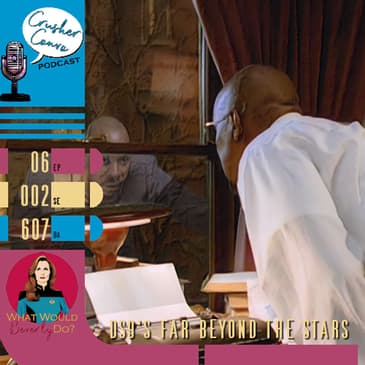
In my "What Would Beverly Do?" segment, I sit down with Ro from Scarif Podcast, to discuss DS9's episode "Far beyond the Stars" and hit the hard topics of racism and equality.
NOTE: These episodes are off a LIVE broadcast that you can see at my YT channel @CrusherConvo. You can also find me on Instagram and Threads! I am not affiliated with Gates McFadden or her team. This is a fanbase podcast that just admires and enjoys her work!
Website: crusherconvo.com
TeePublic: teepublic.com/user/crusher-convo
Patreon: patreon.com/CrusherConvo
Buy me a Coffee: buymeacoffee.com/crusherconvo
[00:00:00] I think I'm saying that we struggle all our lives to answer it. But it's the struggle that is important. That's what helps us to define our place in the universe. This is Beverly, Dr. Beverly, Dr. Beverly Crusher. Honest. Forceful. Trusting. Brilliant. Strong. Adventurous. And this is Crusher Convo.
[00:00:30] Hey guys and welcome to Crusher Convo where we are crushing the conversation one episode at a time. Today I have one great sci-fi expert who didn't realize how much he liked Star Trek until recently.
[00:00:44] I have Ro from Scarif Podcast to help me discuss DS9's Far Beyond the Stars in my What Would Beverly Do segment. Hey Ro, how are you? Fantastic. Jesse, how are you doing? Good to be here. Good to be seen. Good to be here in the Delta Quadrant.
[00:01:01] No, the Alpha Quadrant. It's Alpha Quadrant, yes. My quadrant is correct. Ro, I do have this one question before we get into it. Why do you like Star Trek and why is it Beverly Crusher? I'm just kidding.
[00:01:17] It's funny because you mentioned in the open that I didn't realize how much I liked Star Trek. And I think that started when I met you along with some of the other Star Trek people in our group.
[00:01:33] And I realized you go back into that safe space of watching what you like. Repeat viewings of the original series, next generation, etc. And then you're like, wow, I'm like a big frickin' nerd.
[00:01:54] It's like I like all the Star Treks and the Star Wars and stuff like that. But it is interesting because... Sparky. Yeah, it's... I guess, obviously my first love is Star Wars. But in the 90s, and we've said this before, during the Dark Times,
[00:02:15] the Dark Period where there was no Star Wars at all, we had to get our fix somewhere. And I think for me, Star Trek in the 90s really fit the bill. There was the UPN network started with Voyager.
[00:02:33] And then obviously you had Star Trek of the next generation. At one point, there were like three Star Trek TV shows on at the same time. Which to us was like, oh my God, science fiction on television is fantastic. And it's great.
[00:02:51] So I'm really happy that I'm part of two really cool families. Right. Star Trek, Star Wars. It's just a lot of fun. There are obvious differences between the two franchises which you and I have discussed at length on many occasions. But I always love talking sci-fi with anybody.
[00:03:19] And speaking of group, some wonderful people in my chat. I know we're simulcasting on both of our channels. Yeah. I like this one. We're all nerds but we're cool nerds. Absolutely. We got to love that. Now, Danny's correct. There are different franchises. What are you talking about?
[00:03:44] It's all just one big happy family. That is correct. I'm going to go over here. And then he's saying, Ro, hello. So yeah. Ubaldo and I are going to get into some trouble soon. You got to come out to Chicago. Yeah. Causing havoc over there. Absolutely. David Jones.
[00:04:10] I saw you with Josh. And it is now tradition. I don't know if you heard but anytime David shows up, we have to mention how handsome he is. I caught on when I was watching Josh's thing. I was like there's a theme going on here.
[00:04:30] Yeah we had him a while ago. And you know, I remember saying that I'm not afraid. I'm secure enough to say that you're a nice looking dude. And then they said the same thing on Josh's show. So it's hilarious.
[00:04:45] So every time I mean when he's back on the Scarce Scuttlebub podcast, we'll make sure to carry that tradition. Well, I was going to say that no matter what, you know, nerdy podcast he decides to join, we'll just continue the tradition. Just let everyone know.
[00:04:59] So if he ever comes on mine, you know, I'll make sure to say the same thing. And it won't end like that. So anyways, I guess we'll go ahead and start to crush it, which we're going to do the little breakdown of this episode.
[00:05:14] I do have some fun facts. So stars was a teleplay by Iris Steven Bear and Hans Bindler. Story by Mark Scott-Sacree and directed by Avery Brooks. Now, so of course everyone knows the episode is Experiencing a Vision from the Profits. Cisco sees himself as Benny Russell,
[00:05:40] a science fiction writer in the 1950s who struggles with civil rights and equality when he writes the story of Captain Benjamin Cisco, a black commander of a futuristic space station. And I thought this was interesting. So I'll try and make this as brief as I can.
[00:05:57] So Sacree's original pitch focus on Jake Cisco, a writer of the science fiction writer, rather than his father, he was actually experiencing a vision. He traveled through time back to the 50s, met a group of struggling science fiction writers.
[00:06:11] However, at the end of the episode it was revealed that he never time traveled at all. It was all part of a trick played on him by an alien who wanted to find out something about humanity. Now, Bear didn't like the idea of seeing.
[00:06:23] It felt a little like a gimmick. There was no bottom to the story. It turned and so he turned it down. However, he did like the backdrop concerning science fiction writers in the 50s. So he kept that in mind and several months later he decided
[00:06:36] to switch the protagonist to Cisco, his father, Ben Cisco, and introduced the theme of racism. It is unusual break in protocol, but he pitched the idea to Sacree and asked him to write a story based upon it. And as he did, Bear took a story outline
[00:06:54] and along with Hans Weimler composed a script. And I did want to show the iconic photo here. I love this shot. I mean, he's a great director. He's done a couple of episodes in DS9. He really focuses on the characters, the emotion, things like that.
[00:07:16] So you know, I didn't see what the script said per se, but just to have that there and be able to shoot it and then do the whole effect since the fight that, especially for the 90s. This is awesome. Yeah.
[00:07:32] So but yeah, I love the concept of the episode in a recent episode that I did with Abby. We were talking about best Beverly outfits. I had asked her what holodeck, you know, program would she do?
[00:07:45] And I had told her that if I had ever done a holodeck program, I would go April 15th, 1947. Here comes Jackie Robinson, you know, first and major league baseball and he is just my, my favorite. And so when I was watching this episode,
[00:08:02] because I think this was set in 1953, I got a lot of those what Jackie Robinson had gone through while he was playing professional baseball as what Michael Dore character had mentioned. You know, unfortunately it was New York Giants, but I'll let slide.
[00:08:18] But, you know, it was one of those things where that was still going. Even though Jackie had been on the team for years, there was already other black baseball players and stuff. It was just couldn't even walk down the street. Right.
[00:08:34] And I liked that bear brought it into even Star Trek because it was about to, you know, it shows this is our future. Right. He was a captain of this space station. We just saw a discovery that just ended where it was a female
[00:08:49] black captain, you know, and she was an admiral. And, you know, Wipi Goldberg had mentioned she loved Star Trek because she saw you hurrah on the bridge. She wasn't a maid. She was actually like, you know, the bridge officer. Yeah.
[00:09:04] And that's the future that we all are striving for. Just equality. Everyone working together, just having that hope that things will change. Right. So when you saw the episode, what was your first take on it when you rewatched it?
[00:09:23] Because you have, you know, I know you've seen DS9 before. Sure. I know you had to remind me which episode it was, but I did my homework and I rewatched this episode a couple of nights ago. I wasn't like initially I wasn't, I remember the episode,
[00:09:38] but initially I wasn't sure what the, I guess the base was. I didn't know if he was dreaming and I forgot, I forgot about the whole profits thing where Cisco was supposedly, you know, a profit or the profits from Beijor. I forgot that whole situation there.
[00:10:03] But that timeframe in our real world is interesting to me, you know, right there, that little sweet spot, right before John F. Kennedy was assassinated. And that era of US history really intrigues me because it's almost, there's like an age of innocence that kind
[00:10:27] of starts to get transformed into, you know, not so innocent. Obviously I mentioned the assassination of JFK and then, you know, soon after that you've got, you know, his brother and we start to see, I guess society, I don't know, start to crumble in a way politically.
[00:10:48] And I think a lot of television shows, especially the shows that kind of deal with, you know, putting a lens on humanity like Star Trek does really reflect those stories that, you know, they serve as a reminder,
[00:11:07] you know, for us to take a look at the past so we don't repeat our mistakes. I mean, I think, you know, to some degree, you know, society will continue to repeat the mistakes of the past. It's cyclical.
[00:11:21] But like you mentioned, you know, we are all kind of hoping and striving for some sort of change and hope. But it's interesting because when I watched, when I rewatched the episode, it was, I was intrigued. First of all, I was intrigued that the regular cast
[00:11:37] members, especially the folks that are in heavy makeup were just allowed to act, you know, with no, none of their makeup like Odo. You know, Kira obviously. So I liked that the actors, Michael Dorn, you mentioned, I liked that the actors kind of, you know, were let loose
[00:11:58] to act, to really to be another persona in the show that they all share experiences with. I think when actors do that, I really, I'm happy for them because you get into acting to pretend and get paid for it.
[00:12:13] And, you know, and I would assume that it's a lot of fun. But it's wonderful to be able to see these actors kind of, I don't know, flex their acting muscle and just kind of, you know, free themselves emotionally, free themselves
[00:12:29] in this craft that gives them so much variety. And, you know, with a show like Star Trek, if you're one character, unless the creative people behind the scenes write a really unique script where the character does something different and it makes sense obviously.
[00:12:49] You know, they kind of get stuck in that character. You know, a doctor is always going to be a doctor. You know, one of the bridge officers is going to be, you know, so it's a little monotonous, you know,
[00:12:59] episodic television when you're in one of these television shows. But I loved the fact that these actors really got a chance to, you know, to not play a Klingon on Deep Space Nine or to not play Bajoran.
[00:13:14] So it was really great and I loved, that's one of the aspects of this episode in particular that I really enjoy. Danny says Captain Sisto is her captain. And she says, I want him to hug me and tell me everything is going to be okay.
[00:13:29] And you know, it's funny because we feel that with a lot of, especially our captains, like I know some people who just love Picard or love Janeway or love Cisco and it's just like that's just who they gravitate towards this not because it was their
[00:13:44] Trek. It's just because of what they're representing. Right? I want Janeway to hug me and tell me everything is going to be okay. Just as a side note. Just as a side note, just to throw it in there, right? So hello everyone from Backyard Tardis.
[00:14:01] And then she says, hey Nick, so we got a little party going on in the chat. Always, always. I picked up on that the very first characters first off are the first characters you see part of this dream,
[00:14:14] I guess you could say was the characters that usually have the heavy makeup. So you saw instead of Odo, he was the other, you know, the publisher editor, the main guy. Then it was Michael Dorn who's going and then even Aaron who plays Nog. Oh yeah, that's right.
[00:14:34] Rest in peace. I know it was and it was cool because he was doing this New York accent and he was just like throwing all these little, you know, sayings and stuff. And I remember when I first saw it, I was like, why does it look familiar?
[00:14:49] And then I was realized I was like, you hear the voice, right? You know, obviously if you don't know them, what they look like, you know, behind the makeup, especially not because I mean, the, the Ferengi makeup is like really heavy.
[00:15:01] But you can tell the voices, Armin Schimmerman the same way. It's like, I kind of recognize him. Yeah. Here's the thing with Armin though. All I kept saying was all I saw was principal snipers. From Buffy as well. Right. That's what I grew up on.
[00:15:19] So, but so that's what I saw. And then even with the visitor with Kira, you know, all she has really was the, those things. So she was able to kind of go back and forth quickly. Right. Same with Terry and Jedzia. But I found Terry Farrell.
[00:15:37] Terry Farrell did a wonderful job with her character. She did. She cracked me up. She was all like, oh, she has a worm in her belly. That's disgusting. She just plays, you know, they all put 110% into these fictional characters. You know, these, these doubles that they were doing.
[00:15:56] I did find it interesting though when they were talking, well, when they were showing these different characters and then all of a sudden like Cisco would be Cisco, Captain Cisco and then all of a sudden he's looked and he saw instead of Willie, he saw Worf. Right.
[00:16:15] And I was all like, man, they were in the chair for like four hours to do it. Yeah. I was like, oh man. And they did the same with Mark who was Golds of Cot and then Jeffrey Combs, who was. Why do you?
[00:16:35] It's hard for me to pronounce that name, but that was a split second when he was getting beaten up. But I did like that they use the two villains of Deep Space Nine to be the two FBI would have cops. Yeah.
[00:16:51] So yeah, I thought that was very interesting, but yeah, to see them outside of makeup and do something different, it was very, it was very cool. It was very refreshing, totally different Star Trek. Jay says the acting in this episode is top tier. You are absolutely right.
[00:17:08] Like I said, even when they were their Star Trek characters, they were 110% and then they put it all in there with the situations that was going on with Benny, right? Bringing up. I do want to mention too, because this was about racism
[00:17:28] and injustice, but they did bring up about how it was hard to be a woman writer. And it made me think of DC Fontana. Right, of course. And because I believe I wrote her name down. So Kira was playing Kay Eaton, but her writing name was Casey Hunter.
[00:17:47] And I was like, that is a totally a nod for DC Fontana. So yeah, I liked how that was played into the story. Like it wasn't forgotten. Yeah, very well thought out. Yeah. And you know, and that's just Ira, he took Star Trek to a whole new level.
[00:18:12] He didn't play by the rules. And I think that's why a lot of people love Deep Space Nine because it didn't play by the rules. It opened up a lot of different subjects, even in the future. Because I know Jean Roddenberry really wanted to show hope
[00:18:29] for the future and everyone's getting along at all this stuff. But that's not necessarily realistic because even like you said, we can be striving for better and do better, but there's always going to be those moments where we do fall.
[00:18:43] You know, there's going to be those moments where it's not going to be perfect. So and it makes sense if you're going to be meeting a new species that doesn't know you, they're going to be on their guard. They're going to be defensive.
[00:18:55] They're probably not going to welcome you at first, which was the same with the Klingons when, you know, humans met them. So it's always good to see those conflicts and then see a result whether it was good or bad to those conflicts. Sure.
[00:19:09] So, you know, and I think that's also what played out in this episode as well. Yeah, absolutely. I was kind of skimming through IMDB just to kind of read some of the reviews that the episode had at the time.
[00:19:27] You know, there were a few people that said it was great. There was obviously some people that said it was a little heavy-handed. I don't think it was heavy-handed. I think, you know, within the context of Star Trek, I think, you know,
[00:19:41] we're kind of, I think we're used to these stories. Obviously, you know, the examination of the human condition, especially from the perspective of this group of characters, the science fiction writers in this episode, I think they did a really great job.
[00:20:00] And I keep wanting to say Tex Avery and Tex Avery is a Warner Brothers cartoon director. It's not Tex Avery. What the hell is his name? The actor. Cisco. Every Brooks. I keep wanting to say, I keep wanting to say Tex Avery. Okay.
[00:20:23] I was so confused for a second. I thought you were talking about something else and I was all like, okay, great. You know, I didn't realize that he directed this. You know, it's funny because they're at a certain point, you know,
[00:20:36] when you watch some of these shows, you get to see some of the actors' names in the directorial spot, which is cool. Like obviously, you know, Jonathan Frakes, you have Bala Natora's, who also directs a couple of enterprise shows and she directed some of the Voyager episodes.
[00:20:57] So it's kind of cool to kind of see some of these actors kind of, you know, switch roles and direct them and their colleagues in these shows. It's got to be a very rewarding thing to be able to kind of spearhead an episode,
[00:21:14] especially an episode of this type of story because it does deal with some very important topics and some very deep, racially motivated situations that happened back in the 40s, 50s, etc., etc. So it's really great to kind of see these actors tackle those things on these shows.
[00:21:41] I don't think it was heavy-handed as some people say, but you know, Star Trek, if anything, is one of those franchises that really, you can almost use Star Trek as a textbook when it comes to historical stories and an allegory to the lessons that humanity has learned.
[00:22:05] So yeah, I really dug this episode. Now, it's very true. And I'm sure Ira was all like, Avery, you got to direct this because, you know, to name it was like Patrick Stewart directed LaVar Burton, Michael Dorn, you know,
[00:22:22] and like you said, it was is it Roxanne Dawson? Right. And then of course Gates McFadden did one. And so yeah, it's always nice to see the actors just do something a little different. But I always feel like I could tell when an actor is directing,
[00:22:39] because sometimes they do these different shots that you don't normally see that directors will kind of just, you know, they're just normally doing it, just get the episode going. But the actors really want to show the whole artistic, you know,
[00:22:56] view of the performances and the sets and how, you know, like Gates McFadden, like she did these high shots where it was looking down. So it would be more scarier, right? Because her episode was more scary. I remember one of Patrick's, he was Phantasms, I believe it was,
[00:23:17] which was data was having dreams and stuff. And he did this dolly effect where he was just walking down the corridor and it just kept going. But it looked eerie and you could tell it was a dream because of the way it was scooping around.
[00:23:28] Like sometimes when I look at that, I'm like, I wonder if an actor did this because this is different. This is normally don't see. So Jay Rollquayak says absolutely needed a black voice to tell the story properly. Period. Yes.
[00:23:44] I mean, it would have been a little weird to have anybody else do it, you know, right? And this is actually a perfect said way. So thank you Jay, because I do want to show my favorite scene in the episode.
[00:23:56] So anyone who's in the chat, grab your tissues because every time I watch this, I'm like, I can't finish this. So anyways. To hell with you and to hell with you. Try to stay calm, Benny. I'm tired of being calm. Calm never got me a damn thing.
[00:24:17] I'm warning you, Benny, if you don't stop this, I'm going to call the police. You go ahead, call them. Call anybody you want. They can't do anything to me. Not anymore. And not any of you. My human being. Damn it.
[00:24:40] You can deny me all you want, but you cannot deny Ben Ziskal. It exists. That future at space station. All those people that exist in here. In my mind. I created it. And everyone of you know it. You read it. It's here. You hear what I'm telling you?
[00:25:06] You can pop a story, but you cannot destroy an idea. Don't you understand that's ancient knowledge. You cannot destroy an idea. That future. I created it and it's real. Don't you understand? It is real. We created it and it's real. It's real. Oh, God. Holy prophets. I mean.
[00:25:41] Yeah. And today says it perfectly. It's a crime every brook went in every for that scene. The way he says, I am a human being. Right. You're just like. It's it's powerful. You know, I'm not black, but I am considered a minority. But you can tell.
[00:26:06] You can tell in his voice in his character the frustration. The hopelessness. This is the last straw of being treated. You know, you know, you know, badly or poorly because of the color of my skin. That entire monologue and obviously, you know, done with one shot.
[00:26:31] No cutting away to anything. No reactions. There was one reaction at the beginning, but once he once he kept going, that was it. It was it was powerful. Yeah, it was it was powerful. Yeah. I mean, it reminded me to going back to Jackie Robinson story.
[00:26:52] So when 42 came out, I was super excited and I know a lot of it's for dramatic effect.
[00:26:59] You know, when one of the white players was like, you know, I can't play this game because I have a lot of family are just unhappy with me coming and hear some notes and it was saying you suck and blah, blah, blah.
[00:27:13] And you know, Harrison Ford's character, he's like, oh, well, let me show you what Jackie's been getting. He pulls out this thick file slams it down as low like I hope you die. I hope your baby dies. You know, you blah, blah, blah.
[00:27:29] And he's all like, he's like, and Jackie knows about it, but he still goes out there in place. You know, because that's what Jackie wanted. He just wanted to play ball. He just wanted to play ball. He just wanted to do something. He just wanted to play ball.
[00:27:43] And he was a human being who enjoyed playing baseball. Another favorite though, a little bit off topic, but because back then California wasn't as segregated as of course the South.
[00:27:55] So when Jackie brought Rachel to the South to do, I don't remember if it was a game or auditioning for a game. She saw the whites only on the bathroom. I don't know if this happened. It might have just been for the movie.
[00:28:09] You get used to it and she just went in and just walked right into the bathroom and he's like Rachel. Man, because she didn't care. I need to use the restroom and the other one's too far. So because at some point they're just they're done.
[00:28:25] Absolutely done with the crap. They're done with the crap. And that's why he was all like, this is the future. This is what they were striving for was to be seen, just to be seen. Yeah. And that's what I mean.
[00:28:38] The emotion that just comes pouring out of Avery Brooks' performance in that scene is palpable. You can empathize with his plight and he's had enough by the time of this episode. Yeah. He has had enough. They weren't paying him.
[00:29:01] They weren't printing the story and for the reasons that the characters were talking about, you can't have a black captain in prominence on a space station. And the only way it might be published was because it was a dream. Maybe it was a dream.
[00:29:21] And that would make it okay. And there were characters that said, you know, Benny, come on. It's okay if it was a dream at least it's out there, but he wanted that extra step. Yeah.
[00:29:35] Danny, you're right. He was one of the best actors out there, especially for franchise. Do you remember what he was doing before Deep Space Nine? Remember the show he was on? No, I'd never watched it, but I had heard about it.
[00:29:47] Actually, I think it was on the center seat. They were talking about it. Spencer for hire. It was like, you know, kind of like a Magnum PI. He was the partner. And I always remember him because he always had those cool glasses with the gold rims.
[00:30:01] So he looked all cool instead. Now, of course, Pixel had said that this was a similar storytelling device from the Interlite and TNG, which is true. But with, so here's actually my only like, I don't know, what were the profits trying to teach this go?
[00:30:23] Yes. I mean, that's that was my confusion, you know, first off the bat because it was so abruptly where it was like he's here and I'm all like, well, what was the point of him going through that? Yeah.
[00:30:36] And at the end, he said, you know, I had a vision that Benny was having a dream. But what if we're having the dream and yeah, Benny is real.
[00:30:50] So it almost like lead it like another like five minutes at the end just to do a little more explanation. But I think here's what I think. I think it was it was twofold.
[00:31:03] But I think both of them would apply in the real world versus the Star Trek world. I think it was just designed to show other people. It was designed to put yourself in other people's shoes. Right. That makes sense. Yes.
[00:31:21] And I think I think from a racial standpoint, that is the only way that we can somehow eliminate racial bias is to be able to put yourself in in your neighbors shoes and realize that we all want the same thing. You mentioned Jackie Robinson.
[00:31:41] He just wanted to play baseball just like the white guy. You know, we all want the same thing. We have families. We have careers. We have jobs. We have dreams just like the next guy.
[00:31:54] So I think, you know, Star Trek does that aspect of teaching us, you know, humility, teaching us empathy.
[00:32:05] And really, I mean, science fiction in general does that so, so well because you can, you know, writers can write all of these wonderful stories and wrap them in a shiny package. That is science fiction.
[00:32:21] And I think a lot of the times, you know, you absorb these stories. A lot of times we don't know why we like something. It might be subconsciously. But, you know, consciously we're not aware of a lot of lessons that that we're kind of absorbing through these stories.
[00:32:37] And I think science fiction is a perfect, perfect avenue for that. Oh, absolutely. Now, backyard Tardis says the point was to teach him that sometimes you have to stand up for change even when society norms tells you no Starfleet didn't like him being the emissary.
[00:32:52] That is very true. Yeah. Or even also, oh, he's actually saying more. So he originally intended to revisit the character of Benny, but it fell through. That would have been cool. Yeah. Also at the beginning, his buddy had died.
[00:33:10] Remember that she was letting him know like, wasn't the Saratoga, was like the Cortez or something like that. Oh, that's right. He was very upset and he just didn't like the loss of it. And he felt defeated, you know? So the prophets were teaching him something.
[00:33:28] It ended so abruptly we didn't really get that fulfilling answer at the very end. That's how I feel. It was just kind of abrupt. Like I said, it just needed a little five more minutes. One less Charmin commercial. One less Charmin commercial.
[00:33:47] One less, you know, I know I was going to say Reese's, but I like Reese's. We'll stick with that. But yeah, so the next topic is going to be, oh, Beverly do. She wouldn't take crap. No, not at all. She would be like her, Carmen's character. Yeah.
[00:34:09] The donuts would sway her. Oh yeah, the donuts, yeah. He was like, all right, I'll come back for donuts. She would like screw your donuts. You better publish his story. She wouldn't stand for it. Beverly was always that character who put everyone, even strangers,
[00:34:27] because she was a doctor. Patience, her friends, her family always came first. So if she was put in this predicament being a character, let's say like a KC Hunter, you know, Kira's character. And she was forced to hide. Like she just would know.
[00:34:47] No, she's like, all right, I already have to deal with this crap, but like he almost died because he got upset that his friend was killed. You know, like he was beaten by the cops and it was just,
[00:35:02] and I remember which was Michael Dorn's character as he came in. I know the Cassidy character, you know, she was the waitress and in love with Benny. And she said, you know, with all that money, why are you still living up,
[00:35:17] up, say it or in stuff like that? He's all like they're barely getting used to a black ball player, but they're not going to be used to a black neighbor. And I was all like, man. Yeah. Well, yeah, I mean rooting for him, you know. Yeah.
[00:35:33] And you know what surprised me too was that Jake Cisco's character. I mean, he uttered the N word. Yeah. I mean, they were still, I think, I mean, at that time it was funny. My daughter, she just got the, what's it called?
[00:35:52] Best hits of notorious B.I.G. She's into me right now. Okay. I know it was just like, all right, go for it. And yeah, he drops the N word here and there and stuff like that. And you know, I was all like, wow. Yeah.
[00:36:09] But it was the 90s. But you know what though? I mean, again, it fit into the story's narrative. It fit. What they were trying to tell you and you know, it wasn't frivolous. It wasn't like a gratuitous sex scene or anything that just like didn't matter.
[00:36:29] They were showing how it was. Yeah. So I mean, there was nothing fake about it with the story maybe fiction, but the situations that they were not. You know, oh, we saw him at the crowbar so we had to shoot him. He had a weapon. What?
[00:36:48] It was just, that's what was happening. And it was nice to see that put on screen because what you don't see, you just kind of like, brush it under the rug. I didn't see it so it didn't happen. Sure.
[00:37:00] When you're forced to see it, it changes your perspective on things. Absolutely. Like I said, Beverly would not take this crap. Yeah. And it's funny because I remember thinking during a lot of the office scenes that I really wanted the other writers to kind
[00:37:17] of defend him a little more than they did. I know some of them were kind of hamming and hawing. And then some of them weren't really like the doctor, like the doctor Bashir's character seemed a little on the he was wishy-washy. He was very wishy-washy.
[00:37:34] I almost think that his shots were done separately because the way that they were intercut with the main action were a little bit of a mismatch, but that's more of my television production eye. But, you know, I did want to have the other characters kind
[00:37:52] of defend him a little more against the publisher. But I understand. Yeah. Yeah. Arman's character, like he was very upset and stuff like that, but he was still there. Right. You know, Kira's character, I feel like she just felt this is just how it is right now.
[00:38:12] I don't have much of a choice. Right. She was put in that position. No one can know there's a woman writer writing science fiction. Right. They told her to sleep late. Right. For the photo shoot, everybody needs to have their photo in
[00:38:28] this, in this, but you can sleep late. Yeah. She and Benny knew, oh, I guess we're sleeping late tomorrow because they can't know that there's a black man and a woman writing science fiction. Like it was just, it was well done. Just nothing.
[00:38:47] I mean, I believe it's probably one of the best episodes that they put out there. Sure. There's a lot of good DS9 episodes. DS9 really has some really great, great stories. I think there was one. Big push the envelope. Yeah.
[00:39:03] There's one later in the season with Garak the tailor where they realized that they captured a war criminal and obviously this would have paralleled Nazi death camps and stuff from World War II. And again, just strong characters and strong stories from that show.
[00:39:30] I remember the big controversy when the show was first announced. People were saying how can you have a Star Trek show without a Starship? They're just sitting in a space station. Like what are they going to do? Yeah. That's true.
[00:39:49] I mean, I get it because that was what Star Trek trekking through the stars. Wagon train to the stars. Yeah. Exactly. And yeah, for them to just be stationary in an area and then basically the other aliens and stuff coming to them was different.
[00:40:10] But you kind of have to break it up a little bit. I mean, that's why. Danny, by the way, the Defiant is her favorite ship. It means a lot to her and I understand. I'm sorry. We should have a whole month dedicated just to the Defiant
[00:40:27] just for Danny. We'll have a couple of episodes. What's her birthday month? That would be great. That would be it. What did Riker say? That's a tough little ship and Warf was like, little. Yeah. Cracked me up. You kind of have to break it up a little bit.
[00:40:48] You can't just keep having the same Star Trek show of them being on some kind of ship. What made Voyager different was that they were in a whole quad, you know? And they were trying to get their way home. Makes sense. But yeah,
[00:41:05] but honestly, everyone has something to say about any of the shows when next generation came out. Women doctor. What? A bald captain. He had to wear a T-shirt. Fans are so weird. Gosh. And it was like fun fact.
[00:41:25] I don't know if many people know this, but they added 10 years to Picard's age just because Patrick was bald. That's funny. Yeah. It's so dumb. Instead of a nine year difference between Beverly and Picard, there's a 19 year difference.
[00:41:41] And I'm like, he became bald when he was like 20 years old. Like it wasn't because he was old. It's a condition, you know? And it was just, but it was one of those stereotypes where it was like, oh, you must be old if you're bald, you know?
[00:41:55] So do you have anything else to add with this, with Beverly and all that stuff? Because like I said, she wouldn't take the crap. She would total. I think she would have been the one who would have been more pushy like we wanted from those other characters.
[00:42:11] I wonder if her inclusion would have been detrimental to the episode and how the episode played out. Because she is such a strong character. I think things would have been fixed a little quicker if Beverly Crusher was also a science fiction writer. Yeah.
[00:42:38] She's very quick on solving problems that's why that's her whole thing. She loves the mystery. She loves to help people and she always puts others first, you know? And you're right. Just like, you know, a doctor would do.
[00:42:55] I mean, the oath of the doctors do no harm, et cetera, et cetera. So it's. Now, since a lot of these characters are playing different positions like Cassidy was a server, you know, Worf was a baseball player. Instead of her being a science fiction writer, what an
[00:43:15] adopter, because that would just be too obvious. What kind of profession do you think she would have been at this time? Yeah. Oh, that's a good question. And then do we do we give her the profession and give her
[00:43:31] the attributes that go along with that profession during this time? Because I feel like my first inclination was that she would have been the like the owner of the of the magazine that they're working at. But if you were the owner of that magazine, then you
[00:43:49] would be pressured by your board of directors not to publish. But that would have been an interesting that would have been an interesting little side story where she wants to publish it and her board members don't want her to publish it because he's a black science fiction writer.
[00:44:07] So that would have been. I think two for like Kira's character. She was a women's science fiction writer, but she had to play by the rules in order to keep doing what she wanted, which is total opposite of Kira's character. Right. She didn't play by the rules.
[00:44:25] It would be interesting to see if her that Beverly attributes would have followed into that story or would have she kind of been downgraded a little bit to play along with how what was going on in the 50s.
[00:44:37] Right. Because a lot of times they had to just play along and just do it so that they could just do what they can. Of course, Daddy, perfect dance. She was a dance teacher. Right. Yeah. Or just a school teacher like right like Beverly was
[00:44:52] always one to she loved children. Someone who still nurtures. Yeah. So it would be that would be or even especially at this time theater. Right. She would be a theater teacher or something like that. Or you know what? Like some sort of activist. Yeah. Oh yeah. Yeah.
[00:45:17] That would totally like women's women's rights. That would be so Beverly absolutely. Absolutely. Backyard to make her the nurse that patches him up. Yeah. Little cameo. Yeah. But yeah, dance teacher would be perfect given Gates's background. And you know if you think about this was 1953.
[00:45:42] This was about a time where like Lucille Ball was making a headway of doing big things that no one saw women do at this time. So and she kind of just paved the way for everybody else to do the same. Yeah.
[00:45:59] So I could I could definitely see Beverly's character and some kind of like a teacher role and stuff like that. But yeah, like an activist and just always being on top of everything like that. Always want to do the right thing. Yeah. Yeah.
[00:46:12] I mean she was always against the prime directive because she's like I don't feel this. Yeah. I don't like this at all. Yeah. So do you have any final thoughts? No, you got a lot of Star Trek nerds in the chat. They know their stuff.
[00:46:30] They do know their stuff and it's funny because they know that Gates you know dance teacher, right? Actually I didn't even dawn on me. I feel like an idiot. So thank you Danny for helping me out. But yeah, it was just kind of funny. Oh wow.
[00:46:47] Because I was thinking I was all like if she wasn't just one of the science fiction writers what else would she have done? And currently right now they have those comic books where her character is with Ben Sisko. Like he came back after being gone.
[00:47:00] For that year or whatever. And she's helping him with something. There's like Scotty and Data and Tom Paris is there with the baby. Like all these random characters put together. But it's becoming a really good story. Nice. I needed to do this real fast.
[00:47:26] So this is our next episode. Red Head Alerts to let you guys know that the next episode I'm going to be doing is the third season three one year later. I'm going to have my favorite cosplayer and friend Erin.
[00:47:43] As you can see with her picture down there she loves to cosplay as Beverly Crusher and the big goodbyes one of her favorite episodes. But I kind of wanted to deep dive a little bit after a year of watching season three over and
[00:47:57] over and over again how my views have changed when I compared to when I first saw it. So I thought that that would be lots of fun. So I can't wait. That is actually going to be coming out in two weeks.
[00:48:11] I'm going to be taking next week off. So yeah, I'm super excited about that. Did you love season three of Picard? I definitely loved season three of Picard unabashedly loved it very much. They did just they did a lot of things right.
[00:48:27] They did a lot of things right. Yes. I mean, I think you saw the first two seasons. I do. Some people were like I'm only watching season three. I was like, well, you kind of need to see the first two to kind of understand. Yeah.
[00:48:41] I mean, I would argue that you really don't need to see the second season. It's a. Touche. Touche, yeah. It's a little all over the place. There are good moments. Sure. I think the story about his mom is important.
[00:48:57] But you know, I still don't understand why they would clone him and then leave the sickness in him. What's the point? Well, they didn't leave the sickness in him. I thought they did like he still had the. What was it called the Eremati syndrome? Eremati syndrome.
[00:49:12] No, they kept his body day strum. His new body didn't have it because he won it because it. What did they say? It was soon realized it wasn't the sickness. There was something else going on. So he wanted to test it and he didn't get the chance to.
[00:49:27] So and that's because it was Borg DNA. It wasn't even Eremati syndrome. So, but Danny says my grandma was a dance teacher back then. And then in the 60s she started working for the CIA. May that be at least. Yeah, it would have been.
[00:49:43] Your grandpa is pretty awesome, Danny. My goodness. I mean, my grandparents, you know, they came to from Mexico in the 50s. So that's when my family was planted right here in America. My grandfather was very smart. He was a scientist and a professor, but unfortunately as he had
[00:50:03] to become a citizen here in the States, you no longer have your degree. So he had to do those janitorial roles. Yeah, I had a friend of mine who an older gentleman at the TV station, he was a he was a media sales person.
[00:50:22] But South America where he came from, he was a doctor and scientist. And then he didn't want to go through it all over again. So it's a shame. You can't just kind of take a couple of tests, you know, and then do your thing. Yeah.
[00:50:43] And my grandma was a seamstress. She was doing that on the side. So actually a lot of our clothes that we wore as a kid was made by grandma. And then I said, mama is legit American hero and she's the best. I agree.
[00:50:57] And I never even met your mama. Backyard Tardis says I watched half season one of Picard and then season three, love season three didn't make season one. Season one had its flaws. I personally enjoyed it too.
[00:51:10] It was just all over the place and I just could not get into it. Very, very disjointed. Very disjointed. I really hated what they did with seven and Rafi. Oh, okay. Yeah. Like I don't ship them, but I feel like that.
[00:51:30] I mean, like I should say I kind of do ship them, but like they're not like my top ships. But the thing is, is I'm all you see like a two second scene at the end of season one, oh, then they broke
[00:51:39] up and then, oh, they get back together at the end of season two and then they broke up. And then nothing in season three. I'm like, what the hell? I think again, it's similar to what I feel about the sequel trilogy going into Star Wars.
[00:51:54] It's a pissing match between directors like one director's establishes one thing and then the other director's like, yeah, I don't like that shit. So I'm not going to even do anything. So I just saw each ebb in Voyager. And now that one scene was absolutely heartbreaking
[00:52:12] because I just finished his, his actual story. But I think out of all the characters in Star Trek universe, sevens arc. Oh yeah. I mean, she's coming out where she started and now she's the captain of the enterprise like bravo. Like love it.
[00:52:31] And that's why I'm just, I really want something to see with Rafi and seven and Jack and just see their adventures and Sydney because I think it's a continuation to their story. You know, I think it would be very, very important.
[00:52:42] But yeah, I think that almost like wraps it up. Yeah, pretty good. Great episode. Great discussion. Yeah. Now do you have anything to plug in right now or I think? You know, my co-host and I are gearing up to do new shows.
[00:53:04] But if I have to plug anything, it's all my friends at the Red Five Network, Biolink. So if you guys are into, you know, sci-fi, discussions, talks, audio, YouTube, whatever. You want to be nerdy? Come be nerdy with the Red Five Network. Head on over to biolink.
[00:53:22] Red Five, the number five. We are Red Five. Look for that hashtag and look for the shenanigans wherever you get your other favorite content. I asked my husband the other day. It was all like, when I say Red Five to you, what do you think of?
[00:53:36] He's like, I mean, Luke. Yeah. There you go. I keep telling him too. He's a car-carrying member. I keep telling him, I was like, Ro wants you on his show. He wants to talk to you. He's not like, I don't know what to talk about.
[00:53:55] I was like, you know Star Wars. You know stuff. You know stuff. Actually, I posted this on Twitter. He just got a brand new car and her name's Ripley. And so he was like, I'm going to go off the because all of our cars are named after
[00:54:12] and he's like, I'm going to do something a little different. And at first he almost went and did Decker. So he was almost going that route. He's like, I'm not sure. I was like, your favorite movie is Alien. And he's like, oh yeah, Ripley sounds like,
[00:54:28] I was like, how did you forget that movie? You know, and now with the new movie coming out, he's super excited. My mom's also a huge alien fan, so they like to go on dates. So anytime a new movie comes out, they just go out to the movies.
[00:54:42] That's cool. The only car that I ever named, I had a 1993 Volkswagen Jetta and I called it the return of the Jetta. That's a good one. That's a good one. But thank you to everyone who has been watching on Twitter and YouTube on my channel and Rose Channel.
[00:55:06] Really appreciate it shows that we have like 63 people watching right now. So this is awesome. Anyways, alright guys. Thank you so much and I will see you in a couple weeks. So bye. Cross your out.